Organizers / Give each category a home
Know Where Everything Lives
An organizer earns its weight when it solves a repeated problem. Start with the search you want to avoid, not a matching set.
Organize around moments of use
Think through arrival, changing clothes, washing and charging. A small arrival pouch might keep a charging cable and necessary adapter together. A clothing cube can move directly onto a shelf. A separate bag can stop used socks mixing with clean layers. These are useful functions because they reduce handling at predictable moments, not because every item has acquired its own container.
Start with what you already own. A simple washable bag may be enough for laundry, while a small pouch can hold cables without a dedicated electronics case. Test the arrangement on a short trip before replacing everything with specialist accessories.
Compare cubes without expecting magic
Standard cubes group clothing and can make a top-loading bag easier to manage. Compression cubes use an additional closure to reduce some bulk, particularly with soft garments. They do not remove the weight of the clothes and can create dense, rigid parcels that fit poorly around other items. Overfilling also puts extra stress on zips and seams.
Mesh helps identify contents and can improve ventilation, but it does not protect clothing from rain or leaks. Opaque fabric provides a little more privacy when unpacking in shared spaces. Neither option is inherently superior. Choose dimensions that fit your actual bag, leaving room for irregular items and easy closure.
| Organizer | Good use | Limitation |
|---|---|---|
| Light clothing cube | Keeping outfits or categories together | Adds weight; not normally waterproof |
| Compression cube | Managing compressible clothing bulk | Can make a load dense and inflexible |
| Small zip pouch | Grouping cables or small essentials | Too many pouches can hide duplicates |
| Appropriate dry bag | Protecting selected contents from moisture | Closure and protection rating need checking |
Keep wet and dirty separate—temporarily
A laundry bag is a boundary, not a cleaning system. Damp clothing sealed for long periods can develop odors and mildew. Unpack and dry it as soon as practical. If you need to contain wet swimwear during transport, choose a suitable leak-resistant container and keep the time inside short. Do not assume any lightweight drawstring bag will contain water.
For toiletries, reduce the number of products before reducing container size. Use containers suitable for their contents and follow product instructions. Label unfamiliar liquids clearly. Test closures at home and place potential leaks away from documents, medication and electronics. Airline liquid rules still apply to refillable bottles.
One clear home for each category beats a pouch for every possibility.
Refill, reuse and clean properly
A reusable bottle is useful when you have a dependable source of safe drinking water and a practical way to clean it. Compare capacity, empty weight, opening size and access to seals or straws. An insulated bottle can suit a hot journey but usually weighs more than a simple uninsulated one. Choose the benefit you will use rather than carrying insulation by default.
Nalgene, Klean Kanteen and Hydro Flask illustrate different reusable bottle designs; check the care instructions and replacement-part availability for the specific model rather than assuming all bottles from one brand behave alike. If local tap water is unsafe, a reusable bottle alone does not make it safe. Use an appropriate treatment method or a known safe supply.
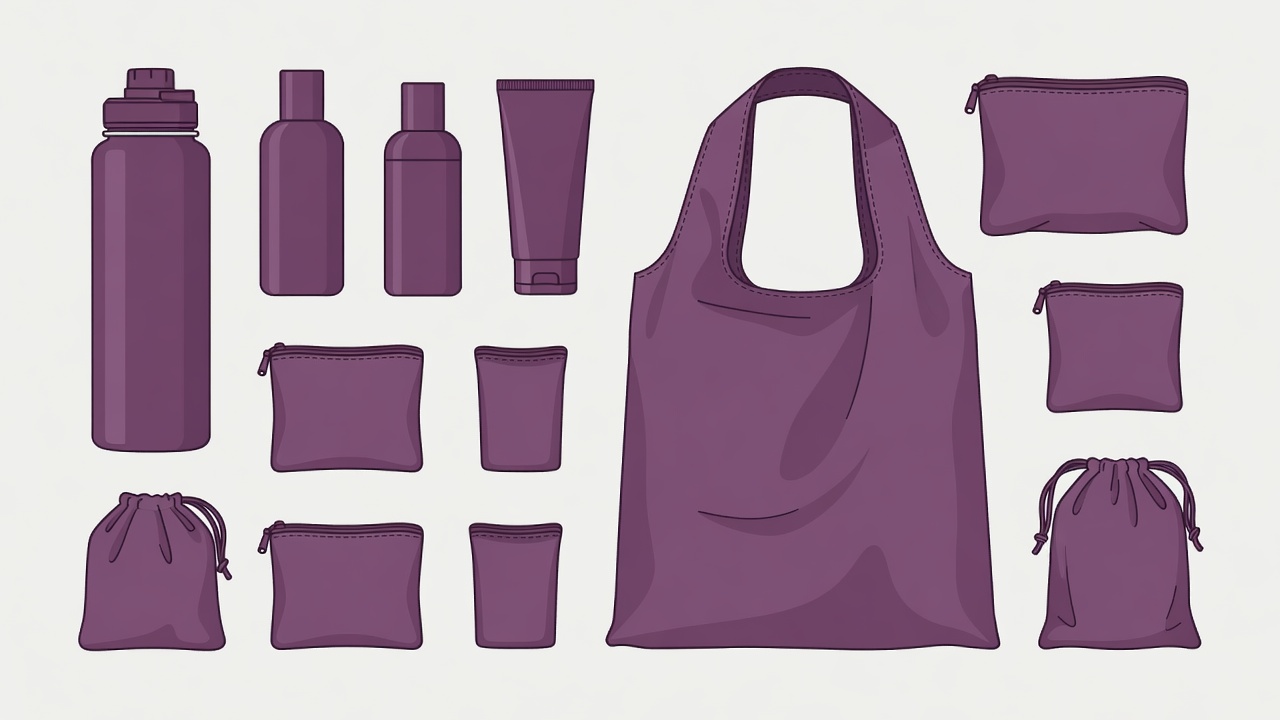
Distinguish convenience from duplication
A cutlery set, cup, food container and shopping bag may all be useful, but not automatically on the same trip. If meals are provided with suitable utensils and you will not prepare food, an extra set may stay untouched. Conversely, a compact food container can be genuinely helpful when you routinely buy groceries or carry prepared lunches. Consider local hygiene requirements and food storage conditions, too.
Environmental impact depends on material, manufacturing, transport, cleaning and how often an item replaces something disposable. We do not assign universal break-even counts. Using a suitable item you already own is often a more practical first step than purchasing a complete new travel set.
Finish with an access rehearsal
Pack the bag and retrieve your most frequently used items without spreading everything across the floor. If you cannot remember which pouch holds an item, simplify the categories or add plain labels. Weigh the organizers together if weight matters to your journey. Keep those that make the load easier to live with, and remove the rest. After returning, clean and fully dry the containers, check closures and store them open where the care instructions allow.