Backpacks / Compare the carry
Fit Before Features
The right backpack carries your actual load comfortably, works with your transport and remains useful after the novelty wears off.
Begin with a representative load
Gather the equipment you expect to carry before deciding on capacity. Clothing volume, food, weather protection and specialist equipment matter more than the number of nights alone. A short cold-weather trip can require more space than a longer journey with regular laundry and indoor accommodation. Published capacity is a useful filter, but it does not explain how easily your awkward items will fit or whether external pockets are included in the stated figure.
Borrowing or trying a bag can reveal more than comparing specifications indefinitely. Use your own load where a shop permits it, or ask for a representative weighted fitting. An empty backpack tells you very little about shoulder pressure, hip-belt movement or how the bag behaves on stairs.
Check torso fit, not just height
Torso length and harness geometry affect where the load sits. Overall height is not a reliable substitute. Follow the maker’s measurement and fitting instructions, because adjustment systems differ. A supportive hip belt should fit your body and work with the pack’s intended load; a narrow stabilizing strap is not equivalent to a load-bearing belt. Shoulder straps should lie comfortably without obvious gaps, pinching or pressure against your neck.
Walk, turn, reach and use steps if available. Notice whether the pack pulls backward or shifts with each movement. Adjustment can improve a suitable fit, but it cannot make every harness work for every body. Compare alternatives rather than assuming discomfort is something you must simply tolerate.
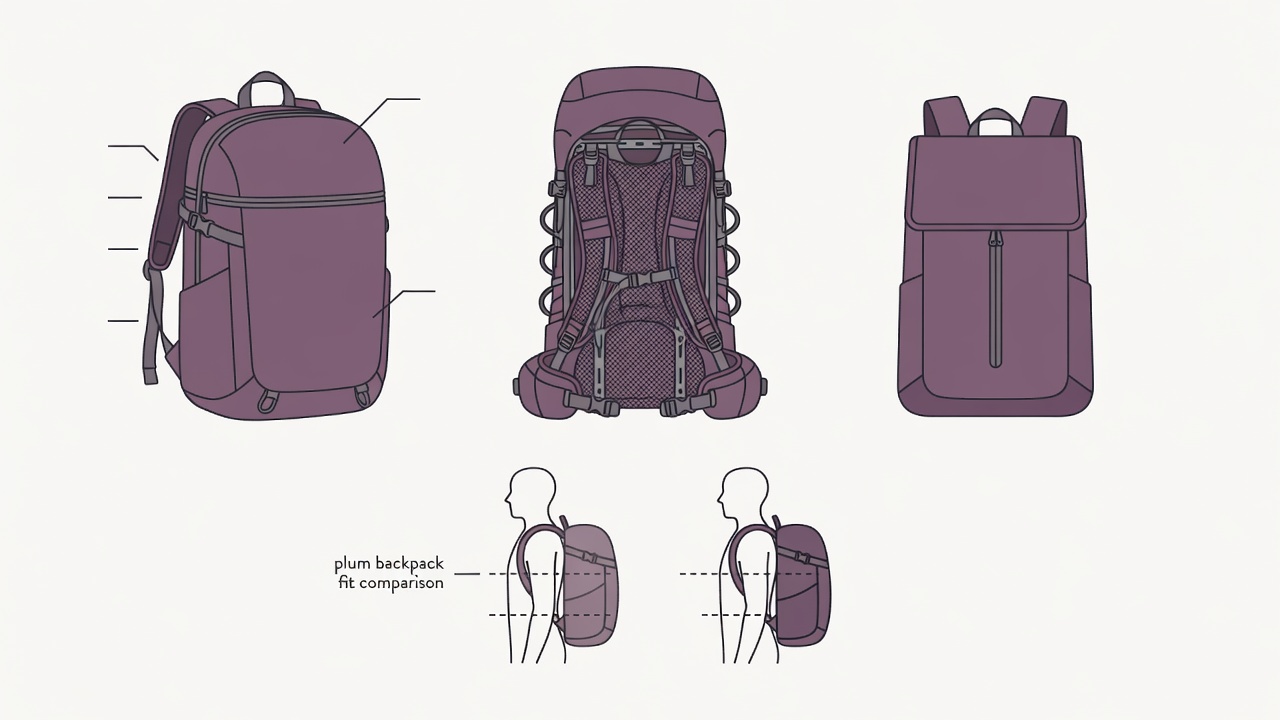
| Type | Useful strength | Question before buying |
|---|---|---|
| Clamshell travel pack | Broad access when unpacking indoors | Is the loaded harness comfortable for your walking time? |
| Framed hiking pack | Support and load control on suitable terrain | Do its shape and straps work for your transport? |
| Minimal daypack | Low complexity for a modest load | Does it remain comfortable with water and layers inside? |
| Roll-top pack | Adjustable closure and simple main compartment | How will you reach frequently needed items? |
Distinguish access from organization
A clamshell opening can make accommodation stops easier, while a top-loading bag may suit a layered trail load. Neither opening automatically creates an efficient packing system. Think about which items you retrieve during travel and which can stay buried. Water, documents and rain protection often need access before spare clothing. Test these actions while the pack is closed and standing as it would during the journey.
Lots of pockets can reduce searching, but they also divide usable space and add zips, seams and weight. A structured laptop compartment is valuable if you carry that device; otherwise it may occupy room without contributing anything. Count features by actual use rather than treating a longer feature list as better value.
The useful capacity is the load you can carry comfortably—not the load you can force inside.
Read materials and repair options carefully
Fabric thickness alone does not predict the lifespan of an entire bag. Construction, abrasion points, zip quality and how you use it also matter. Examine replaceable buckles, accessible stitching and whether repair services are available in your region. A removable component can be helpful, but only if a compatible replacement can actually be obtained.
Osprey, Deuter, Gregory and Patagonia are examples of established brands worth checking for model-specific fit information and current repair policies. Their inclusion here is not an endorsement or a claim that every model shares the same service. Consult current manufacturer pages, including Osprey and Patagonia’s repair information, before relying on a warranty or repair arrangement.
Separate weather resistance from waterproofing
A coated fabric does not necessarily make the seams, zips and openings waterproof. Read the whole product description. A rain cover can reduce direct rain exposure but may leave areas exposed and is not a guarantee against immersion. Protect critical contents with a suitable liner or waterproof container, and check that it closes correctly. Avoid putting leaking toiletries beside electronics regardless of the outer bag’s claims.
Make the final comparison personal
Write down the packed dimensions, empty weight, loaded comfort, access pattern and repair route for each candidate. Check the current rules of every carrier you plan to use. Do not infer airline acceptance from a product name. If two packs both fit, prefer the one whose advantages you will repeatedly use. A heavier supportive pack can be more comfortable than a lighter unsuitable one; a simpler bag can be entirely sufficient for a smaller load.
Next decision: organize the space without filling it with organizers →